Case Studies
One-stop solution for Sheet Metal Fabrication & CNC Machining - Bergek CNC
Language
One-stop solution for Sheet Metal Fabrication & CNC Machining - Bergek CNC
Learn about CNC machining surface finishes including anodizing, powder coating, painting, and clear coat. This guide compares durability, cost, and best applications, helping you choose the right finish for your CNC parts. Additional options like plating, passivation, and electropolishing are also covered.
When customers order CNC machined parts, they often ask:
“Which finish should I choose?”
“Is powder coating stronger than paint?”
“How can I make aluminum look premium?”
Surface finishing is not just about looks. The right finish can:
Protect parts from rust and corrosion
Improve resistance against scratches and daily wear
Make products look professional and high-quality
Extend the working life of components
| Finish | Appearance | Durability | Cost | Best For | Limitations |
|---|---|---|---|---|---|
| Anodizing | Metallic, many colors | Good corrosion resistance, harder surface | Medium | CNC aluminum enclosures, electronics housings | Only works on aluminum; color shades may vary |
| Powder Coating | Smooth, solid color | Strong, highly resistant to rust and scratches (lab tests show years of protection) | Medium (cost-effective in batches) | CNC steel brackets, automotive covers, industrial enclosures | Not suitable for very tight tolerance parts |
| Painting | Flexible colors, custom designs | Moderate, may chip or fade outdoors | Low | Prototypes, short-term CNC projects | Less durable for outdoor or high-wear use |
| Clear Coat | Transparent gloss, natural metal look | Basic protection (good indoors, weak outdoors) | Low | Display pieces, cosmetic panels | Minimal protection, mainly decorative |
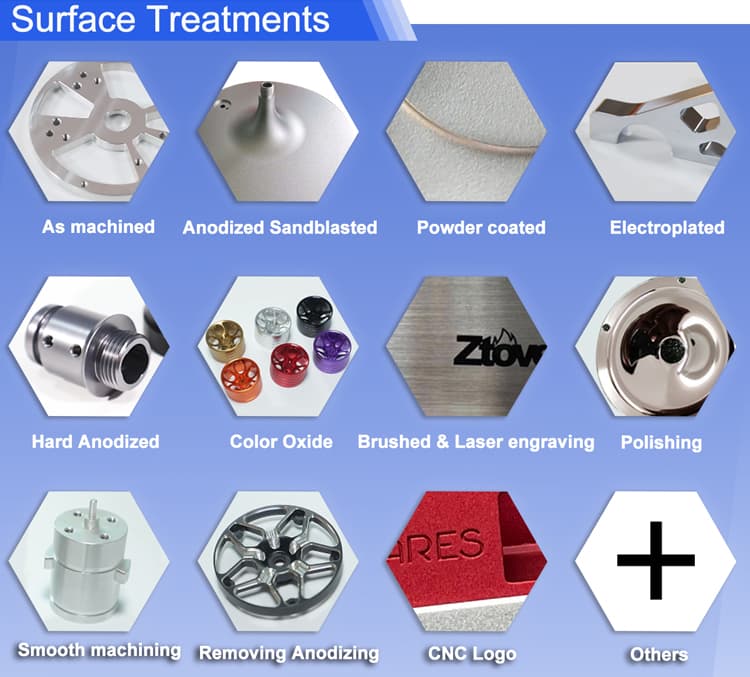
Premium aluminum look → Anodizing
Outdoor protection → Powder coating
Low-cost prototype → Painting
Glossy natural metal → Clear coat
Note: Laboratory test results often represent the best-case scenario. Real-world performance depends on environment, UV exposure, and handling conditions.
Electronics → Anodized aluminum cases protect devices and add color options.
Automotive → Powder-coated CNC steel parts resist rust on brackets and frames.
Prototypes → Painted samples offer fast turnaround and flexible colors.
Display Parts → Clear coat preserves the natural shine for indoor products.
Visual tip: Place application photos (e.g., anodized phone housing, powder-coated automotive bracket).
“We switched from painted enclosures to powder coating. The finish lasted much longer in outdoor use, and customers immediately noticed the improved quality.” — Industrial Equipment Manufacturer, Europe
“Bergek CNC suggested anodizing for our aluminum parts. The color finish looked premium and passed our salt-spray testing.” — Consumer Electronics Supplier, USA
Q1: Is powder coating always better than painting?
Yes, powder coating is usually thicker and more durable. It’s ideal for outdoor and heavy-use parts. Painting is cheaper and faster for small batches or prototypes, but less durable long-term.
Q2: Can all metals be anodized?
No. Anodizing is an electrochemical process that builds the oxide layer on aluminum. It works well on alloys like 6061/5052, but not on steel or high-silicon die-cast aluminum. For those, plating or passivation is recommended.
Q3: How long does clear coat protection last?
Clear coat provides only light protection. Indoors, it may last 6–12 months. Outdoors, unless UV-blocking resins are used, protection usually lasts only a few months.
Q4: Which finish is cheapest for prototypes?
Painting is usually the most budget-friendly option for prototypes or samples, especially when only color appearance matters.
Q5: Can I get custom colors?
Yes. Both anodizing and powder coating allow a wide range of colors. Painting is also flexible, but may fade faster over time.
Q6: Which finishes are suitable for medical or food-grade CNC parts?
Electropolishing and stainless steel passivation are commonly used because they create smooth, clean surfaces that are easy to sterilize.
At Bergek CNC Machining Service, we guide clients to select the right finish by considering:
Material of the part (aluminum, steel, stainless steel)
Application (indoor, outdoor, cosmetic, functional)
Budget and production volume
👉 All finishes are provided under our ISO 9001 quality system, ensuring consistency and reliability from prototypes to production.
Choosing the right finish makes CNC machined parts more durable, functional, and attractive.
Get In Touch With Us!
Bergek CNC is a world-class manufacturing service provider in Shenzhen. We have advanced equipment to provide a full range of customized products to manufacturers around the world, specializing in CNC machining and sheet metal processing.
If you have any question,please contact us.

Copyright © 2026 SHENZHEN BERGEK TECHNOLOGY CO., LTD. - www.bergekcnc.com All Rights Reserved.

