One-stop solution for Sheet Metal Fabrication & CNC Machining - Bergek CNC
Language
One-stop solution for Sheet Metal Fabrication & CNC Machining - Bergek CNC
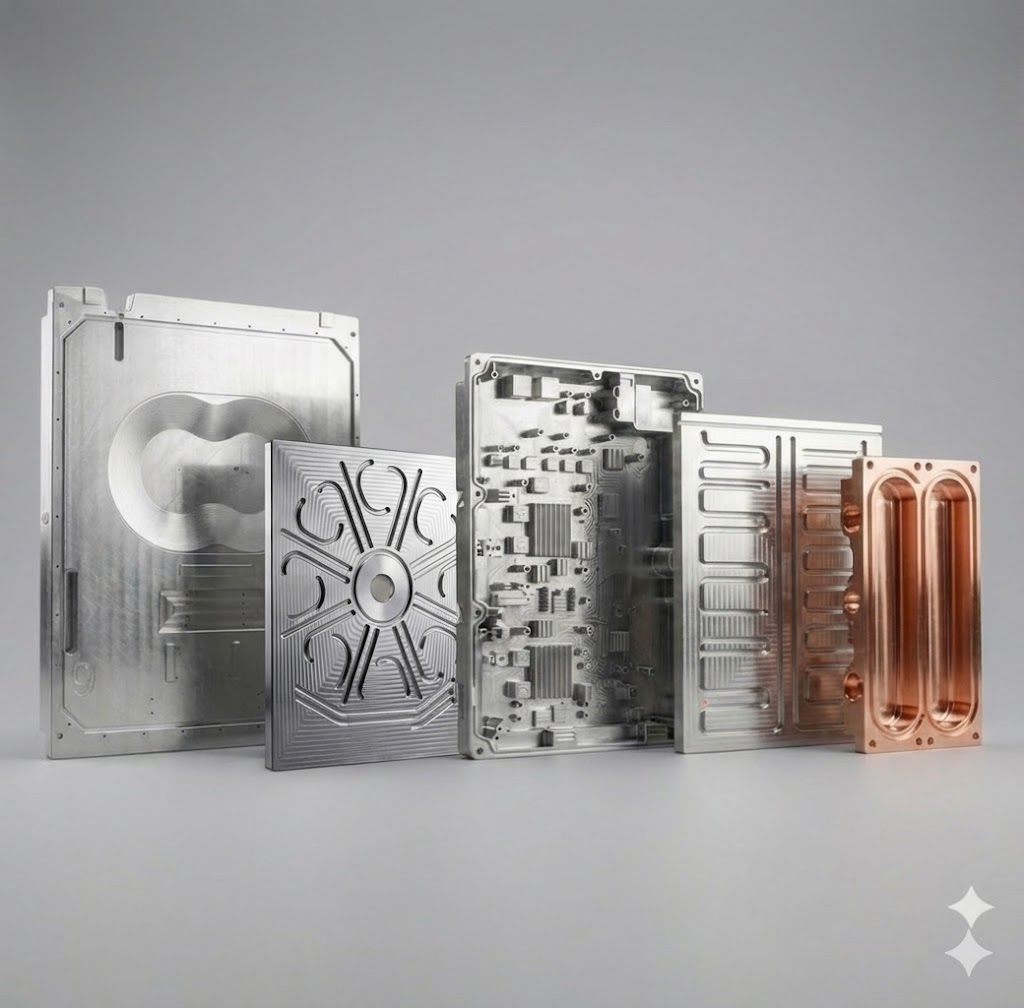
For most CNC-machined liquid cooling plates, the typical control ranges for key tolerances are as follows: the critical channel path depth accuracy can usually be controlled within a range of ±0.02 to 0.05 mm; the flatness of assembly surfaces can generally be guaranteed within ≤0.05 mm; simultaneously, sealing surfaces designed to match silicone gaskets or O-rings can achieve the required surface quality and fit accuracy through precision milling.
For most CNC-machined liquid cooling plates, the typical control ranges for key tolerances are as follows: the critical channel path depth accuracy can usually be controlled within a range of ±0.02 to 0.05 mm; the flatness of assembly surfaces can generally be guaranteed within ≤0.05 mm; simultaneously, sealing surfaces designed to match silicone gaskets or O-rings can achieve the required surface quality and fit accuracy through precision milling.
These tolerance grades are not isolated technical indicators; they directly impact the cold plate's sealing reliability, contact thermal resistance, and overall cooling efficiency in practical operation. For example, strict depth tolerance helps ensure flow uniformity, while high flatness is fundamental for achieving low thermal resistance at the interface. Therefore, the mentioned tolerance ranges are typically capable of meeting common requirements for mechanical compatibility at the thermal interface and stability of thermal performance in applications such as IGBT modules, laser diode assemblies, and other high-power-density equipment. In practice, excessively tight tolerances beyond actual thermal or sealing requirements may significantly increase machining cost and lead time without delivering proportional performance benefits. In actual project design and machining, the specific tolerances that can be consistently achieved in practice also require comprehensive consideration of factors such as the overall part dimensions, material properties, specific process routes, and cost-effectiveness.
In practice, tolerance recommendations provided by Bergek CNC are limited to manufacturability, process stability, and cost-effectiveness considerations, rather than functional or system-level design decisions.
Get In Touch With Us!
Bergek CNC is a world-class manufacturing service provider in Shenzhen. We have advanced equipment to provide a full range of customized products to manufacturers around the world, specializing in CNC machining and sheet metal processing.
If you have any question,please contact us.

Copyright © 2026 SHENZHEN BERGEK TECHNOLOGY CO., LTD. - www.bergekcnc.com All Rights Reserved.

